


AI is reshaping how building information is managed, accessed, and used across the entire asset lifecycle. As organisations face growing portfolio complexity, rising expectations for operational efficiency and increasing regulatory pressure, particularly from legislation such as the Building Safety Act, the industry is turning to AI not just as a technological upgrade but as a necessary evolution.
Yet the success of any AI initiative depends on one critical factor: the quality and structure of the building data behind it. Without strong data foundations, even the most advanced AI tools cannot deliver accurate, reliable insights.
This blog explores why structured, organised building information is the key to unlocking AI’s full potential within the field of building asset management, and how asset owners can prepare their data to take advantage of it.
Find what matters
The Data Foundations for AI-Driven Building Information

Why AI will transform building asset management—but only if the data is ready
The built environment is undergoing a critical transformation. Regulatory pressure, operational risk, and the increasing complexity of managing large property portfolios have made digitised information essential more than ever.
Yet in most organisations, even today, building data remains scattered, inconsistent, and difficult to find, spread across generic storage systems, personal drives, desktops, and disconnected platforms all in different formats and folder structures. While the information exists, accessing it is slow, unreliable, and heavily dependent on individual knowledge rather than structured processes.
ARC Facilities Survey
Facility employees can spend 1–2 hours per day searching for building management information.
At the same time, AI across construction and property management is accelerating. Asset owners, building operators, and facilities teams are increasingly turning to AI to extract information, support maintenance, improve compliance, and enhance decision-making.
The potential is enormous: instant answers instead of hours of searching; context-rich insights instead of static documents; proactive operations and decision-making instead of reactive firefighting. But there is one foundational truth — AI can only deliver value when the data behind it is clean, structured, and centralised.
Asset Infinity Survey
80% of employees waste an average of 30 minutes per day “retrieving information” in manual/process-inefficient environments.
Why can AI fail?
Most building information today simply isn’t ready for AI. Documents are inconsistently named, scattered across multiple systems, or stored in formats that weren’t designed for easily surfacing data long-term asset management. Even when data is digitised to meet compliance obligations, it is rarely organised in a way that enables AI to interpret it correctly or deliver dependable answers.
This becomes especially evident with generic AI tools, particularly those plugged into broad document storage platforms like SharePoint or Dropbox. These systems weren’t built with the nuances of building data in mind. They struggle to enforce the granular permissions required across different projects, buildings, sites, or user roles. Folder and file structures, meta-tagging and document categorisation must be set up manually. And they lack the robust audit trails, version histories, and supersedence controls essential for maintaining a golden thread of information.
Then, these tools, especially when generic AI is applied, cannot always find the right information or trace an answer back to a specific document or the correct version. The insights they generate may be incomplete, outdated, or simply wrong. Instead of creating clarity, they risk compounding confusion and mirroring existing data issues rather than resolving them.
How AI in building asset management works when the data is right
When building information is validated, standardised, and organised within a dedicated platform, embedded AI becomes a reliable intelligence layer, not a guesswork engine. Instead of forcing multiple systems to talk to each other, organisations should bring AI to structured building data, not the other way around. Uploading data into an AI tool and then having to structure it to make sense takes time and energy. When the data is already structured in a solution, purpose built for the job at hand, then the data is ready, and the AI can deliver the answers you need.
This is the core idea explored in Find What Matters: The Data Foundations for AI-Driven Building Information. The paper emphasises that true AI readiness begins with data that is complete, accurate, consistent, tagged, name consistently and centralised, ensuring that AI models can interpret it accurately and return precise results.
AI and construction handover: why clean data starts on day one
A major point in the building lifecycle is construction handover. This stage often introduces the first, and largest wave of disorganised data into an asset owner’s system. A contractors can deliver thousands of documents in dozens of formats, and without strict templates, naming conventions, file structure and validation processes, in systems or even USBs, that can’t be access properly and this information quickly becomes unmanageable.
For asset owners, taking ownership of the handover process from the start by specifying a solution to their contractors, like Zutec’s Digital Handover solution, is essential to getting manageable data from day one of operations. By defining a structured digital handover strategy and process early, you can ensure that building information is accurate, compliant, and delivered in platform, such as Zutec’s Building Document Management solution, so it is AI-ready from project completion onward.
This approach also aligns with the Building Safety Act and the Golden Thread of Information, meaning data is structured digitally to form a secure, single source of truth, which can be continuously updated so it is accurate, but also accessible to all asset lifecycle stakeholders to ensure safety over the longevity of a buildings life. All in all, this positions organisations to meet regulatory obligations with confidence.
For existing buildings, where records are often scattered or incomplete, or even still in a paper-based format, retrospective migration into a centralised platform is both fast and effective. Zutec helps asset owners consolidate building information, identify gaps, and backfill missing documentation, creating a complete set of data that provides an AI-ready data foundation. Once in a platform like Zutec’s Building Document Management solution, data becomes operational intelligence—bridging the gap between storage and action. Over time, AI can support the enrichment of this information further, supporting the Golden Thread and meaning compliance-led solutions can be added as needed, helping asset owners manage their buildings smarter, safer, and more reliably.
How AI improves property and facility management and day-to-day operations
At Zutec, we have been focused on delivering an AI tool that is truly useful for our users, that will deliver information that really matters. Every capability we develop is grounded in the practical needs of asset owners, where insights are provided that can be acted on immediately.
As an asset owner with structured and standardised data in place, AI can perform as intended. It becomes capable of understanding construction data and building terminology, retrieving the right information instantly, and supplying answers with a cited verifiable source.
Instead of sifting through folders and using manual search, users can now simply ask Zutec:
“What is the warranty on the lift in building A?”
“Show me all fire safety certificates expiring this quarter.”
“Which drawings relate to the mechanical plant room?”
The system returns exact answers with the source document attached. It becomes a 24/7 operational advisor; one that never forgets, never misfiles a document, and never takes a day off.
AI in property management: what are the real benefits?
For property and asset management teams, AI unlocks efficiency and consistency across entire portfolios. With thousands of documents per building, instant information retrieval eliminates bottlenecks and reduces reliance on individual expertise. The benefits include:
Faster operational decisions
Teams can instantly locate warranties, O&M details, service detail, and compliance documents, enabling them to make decisions quickly and resolve issues or approve works within minutes rather than hours or days. This accelerates day-to-day operations and reduces downtime and costs across building portfolios.
More proactive maintenance planning
By surfacing upcoming expiry dates, service details, and critical asset information, AI helps teams anticipate, not react to, maintenance needs. This leads to fewer unexpected failures, smoother scheduling, and better asset lifecycle management.
Reduced compliance risk
Instead of scrambling for certificates, inspection logs, or safety documentation, AI provides immediate access to verified records. Teams can quickly demonstrate compliance during audits and ensure they always remain up to date with regulatory requirements.
Improved knowledge continuity
When information lives in a central system rather than in people’s heads, organisations avoid losing critical knowledge when staff members change roles or leave. AI ensures consistent access to building information, keeping operations resilient and uninterrupted.
Consistent data access across teams and buildings
Whether managing one building or a nationwide portfolio, when information is in a solution like Zutec’s Building Document Management, embedded AI delivers the same high-quality, information to every team member. This eliminates discrepancies in how data is accessed or interpreted and drives standardisation across regions, functions, and project teams.
Why a purpose-built AI platform matters more than ever
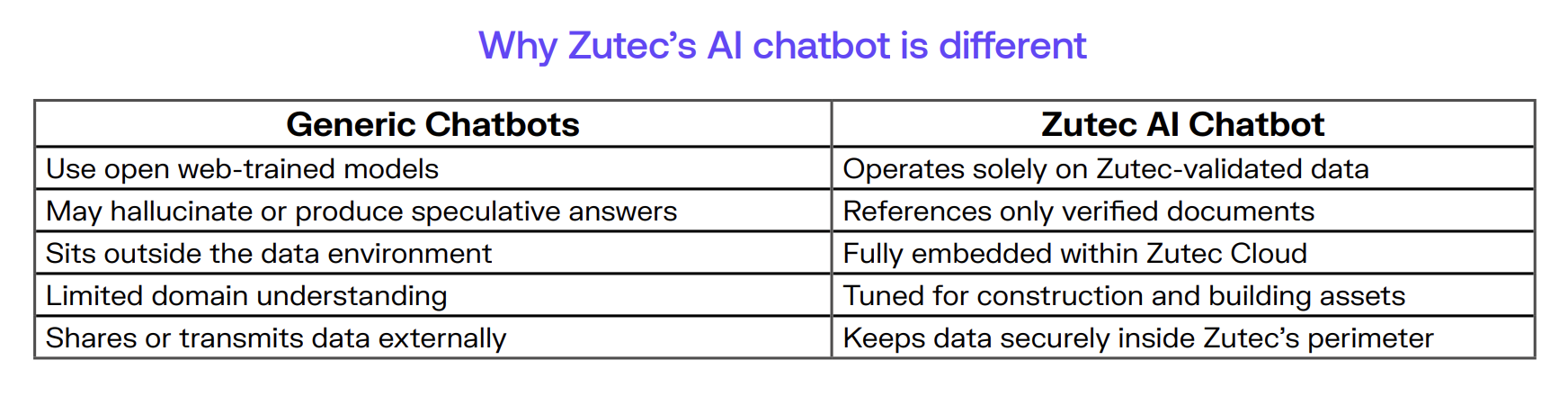
Generic AI tools struggle to make sense of fragmented building data, throwing out far more errors and hallucinations than purpose-built AI. This is why solutions tailored specifically for purpose, such as construction, asset management, and compliance are so crucial.
Zutec’s AI is built with this purpose in mind. Operating entirely within the Zutec platform and cloud, it ensures that no data ever leaves the secure, trusted environment. All processing, retrieval, and reasoning happen inside Zutec’s perimeter, with information strictly segregated per customer to guarantee privacy and compliance. By design, this eliminates the risk of cross-tenant data exposure or model leakage.
Unlike open web-based AI or generic tools, Zutec’s AI uses a retrieval-based architecture, meaning every answer is directly linked to verified building documentation rather than generic internet-trained content. This approach gives users confidence that every response is accurate, compliant, and actionable.
The results are clear: faster, more informed decisions, instant compliance readiness, consistent insights across the portfolio, and significantly reduced operational risk.
How to get your building data AI-ready
Preparing for AI doesn’t start with buying a tool, it starts with transforming the data itself. Organisations that focus on structured, validated, lifecycle-aligned information will be the ones who fully unlock the potential of AI for construction, operations, and property management.
This is not just a technical upgrade. It is a strategic shift in how building information is captured, managed, and used.
For a deeper look at the data models, lifecycle frameworks, and best-practice approach to preparing buildings for AI, download the full paper, Find What Matters: The Data Foundations for AI-Driven Building Information.
If you think it’s time to turn building information into a true strategic asset and put AI to work the right way, join the waitlist for Zutec AI.
Join the waitlist for Zutec AI
Get accurate, document-backed answers immediately via our intelligent conversational AI.
